Home›Blog ›X-Ray Collimator for DR Systems: Manual vs Motorized — Which One Fits Your Workflow?
X-Ray Collimator for DR Systems: Manual vs Motorized — Which One Fits Your Workflow?
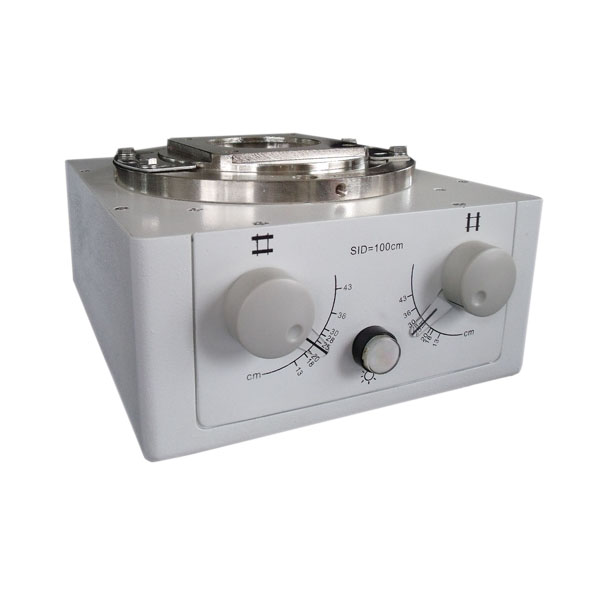
Most DR rooms are planned around three parts: the generator, the detector, and the table or wall stand. The collimator is often added last. That is a mistake.
Your radiographer touches the collimator more than any other part of the system — many times a day, on every exposure. The choice between manual and motorized is not about price tiers. It is about patient volume, exam mix, and how much of the day your staff spends turning knobs instead of positioning patients.
This guide compares both types on four points: speed, ease of use, dose control, and maintenance cost. A selection guide follows.
1. What the collimator does
It sits between the tube and the patient and shapes the X-ray beam. Four jobs:
Shapes the field. Four lead or tungsten blades form a rectangle. The blades move independently, so you can make asymmetric fields for trauma or paediatric work.
Shows the light field. A lamp projects visible light that matches the radiation field. The operator can see what will be exposed.
Controls dose and scatter. A tight field means less dose and less scatter. In DR, scatter shows up quickly as lost contrast.
Connects to the room. It carries the lamp, the positioning aids, sometimes a DAP chamber, and now often a motor board linked to the generator.
A manual collimator does these jobs with knobs. A motorized one does them with motors and software. The physics is the same. Only the work changes.
Two or four knobs drive the blades through lead screws. No board, no motor, no firmware.
Good for:
No software faults. Problems are mechanical: a worn gear, a stiff screw, a dim lamp. A biomedical engineer can fix them. No laptop, no service dongle, no firmware version to match.
Works in the dark, with gloves on. Staff find a knob by feel. No menu, no mode button. In a trauma call or at an ICU bedside, that matters.
Low cost, short lead time. A fraction of the price. No control protocol needed from the generator. Often the only option when replacing a collimator on an older room.
Nothing to integrate. No cabling, no limits to set, no field-size mismatch with the workstation.
Limits:
Both hands busy. The operator releases the tube handle, turns a knob, checks the light field, turns the second knob, checks again. About 15 seconds on a chest exam. With 60 patients a day and three adjustments each, that is 30–40 minutes of hand movement — plus repeated release and re-grasp of the tube head.
Asymmetric fields are awkward. Under time pressure, staff default to a centred, oversized field. More dose, more scatter.
No memory. Every exam starts from zero. A department doing the same twelve projections all day repeats the same work.
No data. Nothing records field size, which makes dose audits harder.
3. Motorized collimator
Motors replace the knobs. Control is by buttons, joystick, remote, or the workstation. Better units add auto-tracking, so the field follows the detector or the protocol.
Good for:
Speed on repeat work. Above about 40–50 patients a day, presets win. A chest PA becomes one button press. Auto-tracking sets the field before the patient is positioned. Savings are often 10–20 seconds per exposure — around an hour a day at 250 exposures.
Better ergonomics. One thumb collimates while the other hand stays on the tube head. Over a career, this shows in injury rates.
Tighter fields by default. When collimation is easy, it gets done. Departments that switch often see smaller mean field area on audit — lower DAP, better contrast, no change in technique.
Remote control. A remote or foot switch lets staff collimate while standing at the patient.
Dose data. Blade position and field size can be logged with the exposure.
Limits:
It is a computer. Board faults, encoder drift, limit errors, firmware mismatch. When it fails, the room usually goes down. The manual override is a service function, not a clinical one.
Integration is a project. The unit must match the generator protocol, the console software, and the detector sensing for tracking. Retrofits are where surprises happen.
Higher running cost. Motors and boards wear out. Expect one replacement in a ten-year life, usually a proprietary part.
Training needed. Staff used to manual units will not use presets unless someone shows them. Many motorized collimators end up used as expensive manual ones.
4. Comparison
| Manual | Motorized | |
| Adjustment | 2–4 knobs | Buttons, joystick, remote |
| Hands needed | Both | One thumb, or none |
| Time per change | 8–15 s | 2–5 s; near zero with presets |
| Memory presets | No | Yes |
| Auto-tracking | No | Yes, mid-tier and up |
| Asymmetric fields | Possible, awkward | Standard |
| Dose audit data | No | Yes |
| Failure mode | Wear, lamp, mirror | Board, encoder, firmware |
| Repair | In-house possible | Trained engineer, OEM parts |
| Downtime risk | Low, gradual | Rare but sudden |
| Best for | Low volume, tight budget, mobile use | High volume, repeat worklists |
5. Which fits your workload
Under 30 patients a day, mixed exams. Manual. Motorization will not pay back, presets will not help a varied list, and simplicity is an asset.
30–60 a day, general radiography. The judgement zone. If 70% of the list is chest, abdomen, knee and shoulder, presets earn their place. If the room also handles specials and odd projections, the gain is smaller. Visit a similar department before you decide.
Over 60 a day, or a dedicated chest line. Motorized, with tracking. At this volume, ten seconds per exposure is a staffing argument.
Trauma, ICU, bedside, mobile. Often manual. The tube has to move around lines and tubing, and the operator needs to feel the field, not read a display. Battery-powered mobile units usually use manual or simple motorized collimators.
6. Maintenance and cost
Planned service. Manual needs lamps, light-field alignment, blade cleaning and annual checks. Motorized needs all of that plus actuator checks, calibration and firmware — usually under contract.
Repairs. Manual fails slowly and cheaply. Motorized fails rarely but hard. Annual spend may be similar; the risk per event is much higher.
Downtime. A room that cannot collimate cannot image. With no second room, one lost day can cost more than the price difference. Ask for a spare-parts period and a response time in writing.
Training. Budget half a day. Without it, the features go unused.
Simple version: manual costs less up front and runs flat. Motorized costs more and then steps up at a failure. The crossover depends on volume and downtime exposure.
7. What to ask for
Field range. Maximum field at your SID, and a minimum small enough for paediatric work. Minimum is often missing from datasheets.
Light field accuracy. Get the tolerance, and confirm the test is done at your installed SID.
Lamp type. LED lasts longer than halogen.
Blade control. Independent blades, clear layout, visible position on motorized units.
Control interface. Which type, and does your generator support the protocol? For tracking, confirm the detector model.
Weight. Motorized units are heavier. Check the crane or column rating.
Compliance. IEC 60601-1 and 60601-1-3 documents with the unit. CE marking for the EU.
Service. Spare-parts period, response time, field-replaceable board?
8. FAQ
A:Can I use a motorized collimator by hand if the motor fails?
Most units have a service-mode override. It is not for clinical use. Treat a motor fault as a room-down event.
B:Does motorization reduce patient dose?
Not directly. Dose depends on the field you choose. It helps indirectly, because tight collimation becomes easier, so more people do it.
C:Is manual still acceptable for a new DR room?
Yes. Most markets do not require motorization. They require accurate light-field alignment, proper beam limitation, and documented performance.
D:What volume justifies motorized?
Usually 40–60 patients a day in general work, lower on a dedicated chest or outpatient line. Below 30, the case is about comfort rather than money.
Under 30 patients a day, a varied exam mix, or a mobile and budget-limited setup: choose manual. Simplicity is the feature.
Over 50 a day on a repeat worklist, or ergonomics and dose documentation as department priorities: choose motorized, specify it with the room, and budget for training and service.
Author:X Ray Collimator
X Ray Collimator
Blog
- X-Ray Collimator for DR Systems: Manual vs Motorized — Which One Fits Your Workflow?
- Latest Collimator Specs & Selection Tips
- NK103 C-Arm Collimator Replacement Guide: Compatibility & Installation Checklist
- Collimation in Radiology: Practical Guide for Safe, High-Quality X-Ray Imaging
- Application of collimator for sale to X-ray machines
contact us
TEL:+86 19015366638
E-mail:newheekcn@163.com
Company:Weifang Newheek Electronic Tech Co., Ltd.
ADD:E Building of Future Star Scientific Innovation Industrial Zone of No.957 Wolong East Street, Yulong Community, Xincheng Sub-District Office, Weifang Hi-tech Zone, Shandong Province, China