Home›Blog ›Post-Replacement Commissioning & Calibration for Medical X-Ray Collimator
Post-Replacement Commissioning & Calibration for Medical X-Ray Collimator
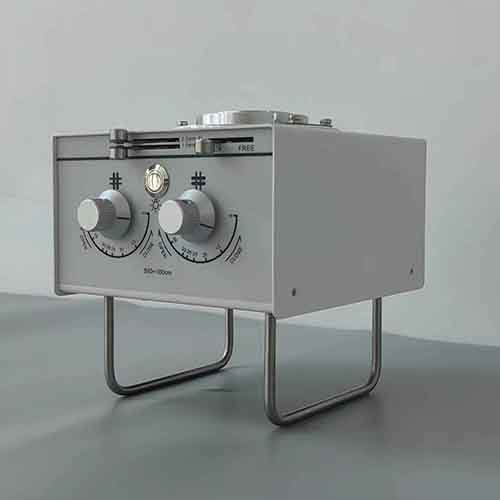
As the core component for radiation protection and imaging accuracy of X-ray systems, the Medical X-Ray Collimator must be commissioned and calibrated in strict compliance with standard procedures after replacement. This standardized process effectively eliminates common issues such as X-ray beam offset, misalignment between radiation field and imaging field, ensuring full clinical safety and regulatory compliance for end users.
Pre-Commissioning Safety Preparation
Before any operation, disconnect the high-voltage power supply of the X-ray system and hang prominent warning signs to prevent accidental power-on. Double-check all mechanical connection points of the Medical X-Ray Collimator to confirm they are fully tightened without any looseness. Prepare all necessary tools in advance: collimation test ruler, calibrated radiation dosimeter, NIST-traceable imaging consistency test phantom. All on-site commissioning personnel must wear personal radiation dosimeters and complete basic radiation protection training before starting work.
Preliminary Mechanical Alignment
Manually rotate the blade adjustment knobs on the Medical X-Ray Collimator to verify that all 4 sets of shielding blades move smoothly throughout the full travel range, with no jamming or stuck positions, and the maximum/minimum opening range fully matches the factory nominal parameters. Turn on the built-in central positioning laser of the Medical X-Ray Collimator, fine-tune the laser mounting position to make the laser crosshair align exactly with the X-ray tube focal spot marker, and control the coaxial deviation between the laser path and the actual X-ray output path within 1mm, to lay a precise foundation for subsequent optical alignment.
Radiation Field & Imaging Field Consistency Calibration
Place the test phantom stably at the exact center of the X-ray detector, and perform low-dose exposure at 50kV with appropriate mAs settings. Compare the actual radiation field boundary output by the Medical X-Ray Collimator with the effective imaging area boundary of the detector. Fine-tune the installation angle of the collimator slightly, repeat low-dose exposure for verification, until the deviation between the two boundaries is no more than 2%. Complete the accuracy verification for all standard radiation field gears one by one, to ensure no X-ray leakage outside the imaging area under any clinical fluoroscopy mode.
Dose Output & Long-Term Stability Validation
Use the calibrated radiation dosimeter to test the central radiation dose of the Medical X-Ray Collimator under standard exposure parameters, confirm that the deviation between the measured value and the factory nominal dose is within ±10%. Test the minimum limit stop function of the collimator to ensure the blades will not cause hard mechanical collision when moving to the minimum closed position. Complete 10 consecutive full opening/closing cycles of the blades to verify that the position repeat accuracy of each adjustment remains stable. After recording all calibration data and generating a formal signed calibration report, the Medical X-Ray Collimator can be officially put into normal clinical operation.
Author:X Ray Collimator
X Ray Collimator
Blog
contact us
TEL:+86 19015366638
E-mail:newheekcn@163.com
Company:Weifang Newheek Electronic Tech Co., Ltd.
ADD:E Building of Future Star Scientific Innovation Industrial Zone of No.957 Wolong East Street, Yulong Community, Xincheng Sub-District Office, Weifang Hi-tech Zone, Shandong Province, China