Home›Blog ›Replacement X-ray Collimator for Mobile & Bedside X-ray
Replacement X-ray Collimator for Mobile & Bedside X-ray
A mobile X-ray machine rarely fails all at once. It fails at the collimator: the field light dims to a yellow smear, one lead leaf stops tracking, or the field no longer closes down for a lateral. The generator, the tube and the detector are all still good — but the unit is out of service, because nobody can position a field they cannot see.
That is the moment this article is written for. Below is how to decide which of our three mobile-grade collimators physically and electrically replaces the one on your machine, which original parts we have already replaced in the field, and the four measurements that decide the answer before you spend money.
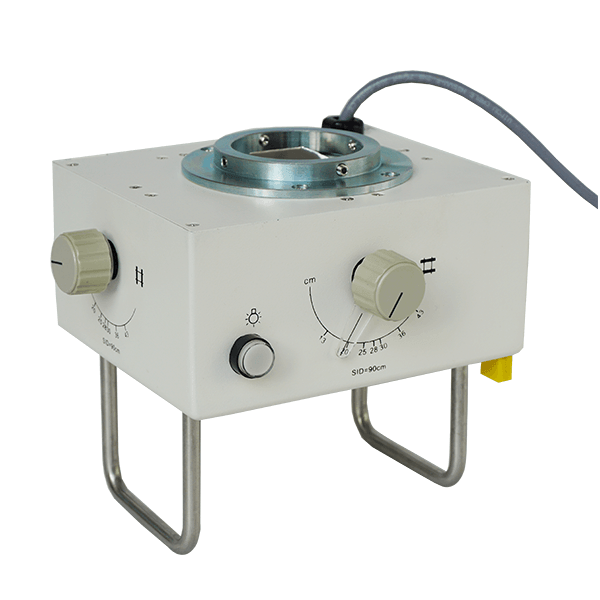
Why mobile collimators fail first
A mobile unit takes more mechanical abuse than a rad room. It is pushed over thresholds, parked against walls, and its collimator hangs as a cantilevered mass off the tube housing.
The failures we see most often:
Lamp end-of-life or a burnt connector. The field light is a consumable. At 30-second duty cycles it is the first thing to go.
Contaminated mirror. Dust and gel ingress haze the mirror that projects the light field. The field looks dim and the edges look soft — technicians read this as “the collimator is dead” when only the optics are dirty.
Lead leaf jam. A bent or galled leaf stops travelling. The field is asymmetric and cannot be squared to the detector.
Cracked output window. Usually impact damage. Radiation leakage at the window becomes a compliance problem, not a convenience problem.
Drive or control board failure on electric units — the expensive case, and the one where a manual replacement often makes commercial sense.
Repair is worth it when the fault is the lamp, the mirror or a single leaf. Replacement wins when the housing is deformed, the window is cracked, the leaf track is worn, or the unit is old enough that the OEM part is discontinued or quoted at a price that exceeds the machine’s book value.
The four numbers that decide fit
Brand and model name do not decide compatibility. These four do. Measure them before you inquire — a supplier who asks for them is a supplier who has done this before.
| # | What to measure | Why it decides the answer |
| 1 | Maximum tube voltage (kV) | The collimator’s rating must be ≥ your machine’s maximum clinical kV. A 125 kV unit on a 150 kV generator is a leakage and liability problem. |
| 2 | Focus-to-mounting-surface distance | The distance from the tube focal spot to the collimator’s mounting face. Get this wrong and the light field will never agree with the radiation field. |
| 3 | Flange bolt pattern | Bolt-circle diameter, hole count, hole spacing. Photograph the joint from two angles — this is faster to confirm than any model name. |
| 4 | Lamp supply voltage | 12 VAC and 24 VAC systems are both common and are not interchangeable without matching the supply or the lamp. |
Add one more, commercial rather than mechanical: maximum field size at your working SID. A mobile unit used for chest work at 180 cm needs more field than one used only for extremities.
Which of our three models fits which machine
| Model | Drive | Max kV | Max field | Focal distance | Lead leaves | Lamp / supply | Weight |
| NK202X | Manual | 150 | 440 × 440 mm @ 100 cm | 60 mm | 2 layers | 24 V / 150 W, AC 24 V | — |
| NK-R102NC | Manual | 150 | 350 × 350 mm @ 65 cm | 55 mm | Continuous, manual | LED, 12–24 V AC/DC | 6.5 kg |
| NK103 | Manual | 125 | 430 × 430 mm @ 90 cm | 40 mm | 1 layer | 12 V / 50 W, AC 12 V | 2.6 kg |
Read that table as three different machines, not three price points:
NK202X — the default for 150 kV mobile DR and bedside units. Two lead layers, 440 mm field, 24 V lamp, 60 mm focal distance. This is the model that covers most modern mobile DR and ward radiography.
NK-R102NC — for 55 mm focal distance and Japanese-style tube heads. It also carries built-in selectable aluminium filters (0 / 0.5 / 1.0 / 1.5 mm Al) and a 1.5 mm Al inherent filtration at 70 kV, which matters on units where the filtration is normally carried in the collimator rather than the housing.
NK103 — the small, light, 12 V option. 2.6 kg and a 40 mm focal distance. It is the model for older portable units and compact tube housings where neither the space nor the lamp supply allows a 24 V assembly.
If your measurement is 60 mm and your lamp is 24 V, the answer is almost always NK202X. If it is 55 mm, start with NK-R102NC. If it is 40 mm and the housing is tight, NK103.
Original collimators we have already replaced
Two cases from our own order file, both on mobile equipment:
Shimadzu R-02J (Japan), on a mobile unit in Peru. The customer’s collimator had failed and the OEM replacement route was slow and expensive. Our NK-202 was supplied as the replacement and fitted the tube without modification.
A Toshiba tube head, on a mobile unit in Tanzania. Here the customer did not know the collimator model — only the tube model and its parameters. We specified from the tube data and supplied the NK202. The unit went back into service.
Both are the same lesson: on mobile equipment, the tube is the reference, not the collimator badge. Send the tube model and the four measurements and the match can be confirmed without the original part number.
Parts customers commonly ask us to cross-reference
The table below lists original collimators that come up repeatedly in mobile and bedside inquiries. It is a starting point for the conversation, not a compatibility guarantee — the four measurements above still decide.
| Original part / family | Typical platform | Our likely match | Status |
| Shimadzu R-02J | Shimadzu mobile / bedside | NK202X | Verified in service |
| Toshiba tube-head collimator | Toshiba-equipped mobile units | NK202X / NK-R102NC | Verified in service |
| Shimadzu R-50 series | Sonialvision-type systems | NK301 / NK305 (larger field) | Confirm flange and field first |
| GE Proteus / Eclipse family | Fixed and mobile GE radiography | NK-RM202 (manual version only) | Confirm — original is automatic PBL |
| Ralco R221 / R302 | Mobile and rad-room | NK301 / NK305 / NK-RM202 | Confirm flange pattern |
When a manual collimator is the wrong answer
Be clear about this before you quote, because it is the most common source of dispute after delivery.
If the original collimator is automatic PBL (positive beam limitation), carries an AEC ionisation chamber, or communicates with the generator over CAN-bus or a serial link, then a manual collimator will physically fit and will produce a correctly limited field — but it will not restore the automatic function.
That is acceptable for many clinics, veterinary practices and refurbishers, provided it is stated in writing. It is not acceptable where the automatic function is part of the site’s licensing or acceptance criteria. In that case the correct route is an electric collimator with the matching interface, and the interface protocol has to be discussed before the order, not after.
Installation and light-field calibration
1. Lock out and let the tube cool. Never loosen a collimator on a powered housing.
2. Mark the orientation across the old collimator and flange before removal — leaf and mirror axis matters.
3. Support the weight before the last bolt comes out. On a mobile unit this is a 3–7 kg cantilever.
4. Seat dry, torque in a star pattern. Residual gasket material causes both leakage and a skewed seat.
5. Verify light field against radiation field at your working SID with a detector and radiopaque markers at low technique. A consistent offset in one direction means the collimator is rotated on the flange; a radial offset means it is not seated.
FAQ
Can I replace just the lamp or the mirror instead of the whole collimator?
Yes, if that is the only fault. On most mobile units the lamp is a consumable and the mirror can be cleaned. If the leaf track is worn or the window is cracked, the assembly is the practical repair.
My machine is 150 kV but I only shoot at 90 kV. Do I need the 150 kV model?
Buy the 150 kV model. Headroom costs little and extends leaf and lamp life; a 125 kV collimator on a 150 kV generator is a compliance exposure regardless of how you actually shoot.
The focal distance on my unit is not 60 mm. Can it be adjusted?
Yes on our standard models — the focal distance is adjustable at build to your measured value. Tell us the measurement at inquiry; it is a standard modification, not a custom project.
How do I know the field will cover my detector?
Calculate the field at your working SID, not at 100 cm. A 440 mm field at 100 cm is not a 440 mm field at 180 cm — check the coverage at the distance you actually use for chest work.
Do you supply the flange adapter if the bolt pattern differs?
Yes, where the pattern is a known type. Send photographs of the joint and the hole-to-hole measurement and we will confirm whether an adapter ring is needed.
Send us four things and we will confirm fit before you order: tube model, flange bolt pattern (photo plus hole spacing), measured focal distance, and lamp supply voltage. Typical confirmation is one business day.
Request a compatibility check →
Author:X Ray Collimator
X Ray Collimator
Blog
- Replacement X-ray Collimator for Mobile & Bedside X-ray
- Medical Mobile X-Ray Equipment Parts: Portable X-Ray Collimator Complete Selection & Maintenance Guide
- Pet X-Ray Beam Limiter, Precise Control for All Veterinary DR
- X-ray collimator manufacturers
- X-Ray Collimator for DR Systems: Manual vs Motorized — Which One Fits Your Workflow?
contact us
TEL:+86 19015366638
E-mail:newheekcn@163.com
Company:Weifang Newheek Electronic Tech Co., Ltd.
ADD:E Building of Future Star Scientific Innovation Industrial Zone of No.957 Wolong East Street, Yulong Community, Xincheng Sub-District Office, Weifang Hi-tech Zone, Shandong Province, China